Here's a number that should bother every moving company owner: 35–40% of virtual survey requests never get completed. The customer agrees to a video call, then cancels. Reschedules. Ghosts. By the time you actually connect, they've already booked with someone who quoted faster.
The problem isn't the customer's intent. It's the friction. Video calls require scheduling. On-site visits require dispatching a rep. Both require the customer to be available at a specific time — and in a market where the first accurate quote usually wins the job, "available next Thursday" might as well be "never."
That's the gap that virtual moving survey software was built to close. Not by making video calls slightly better, but by removing the call entirely.
A traditional virtual survey works like a FaceTime appointment. Your sales rep dials in, the customer walks room to room, and the rep manually notes items on a clipboard or digital form. It's better than driving out, but it still depends on two people being available at the same time — and the rep's ability to count accurately while managing the conversation.
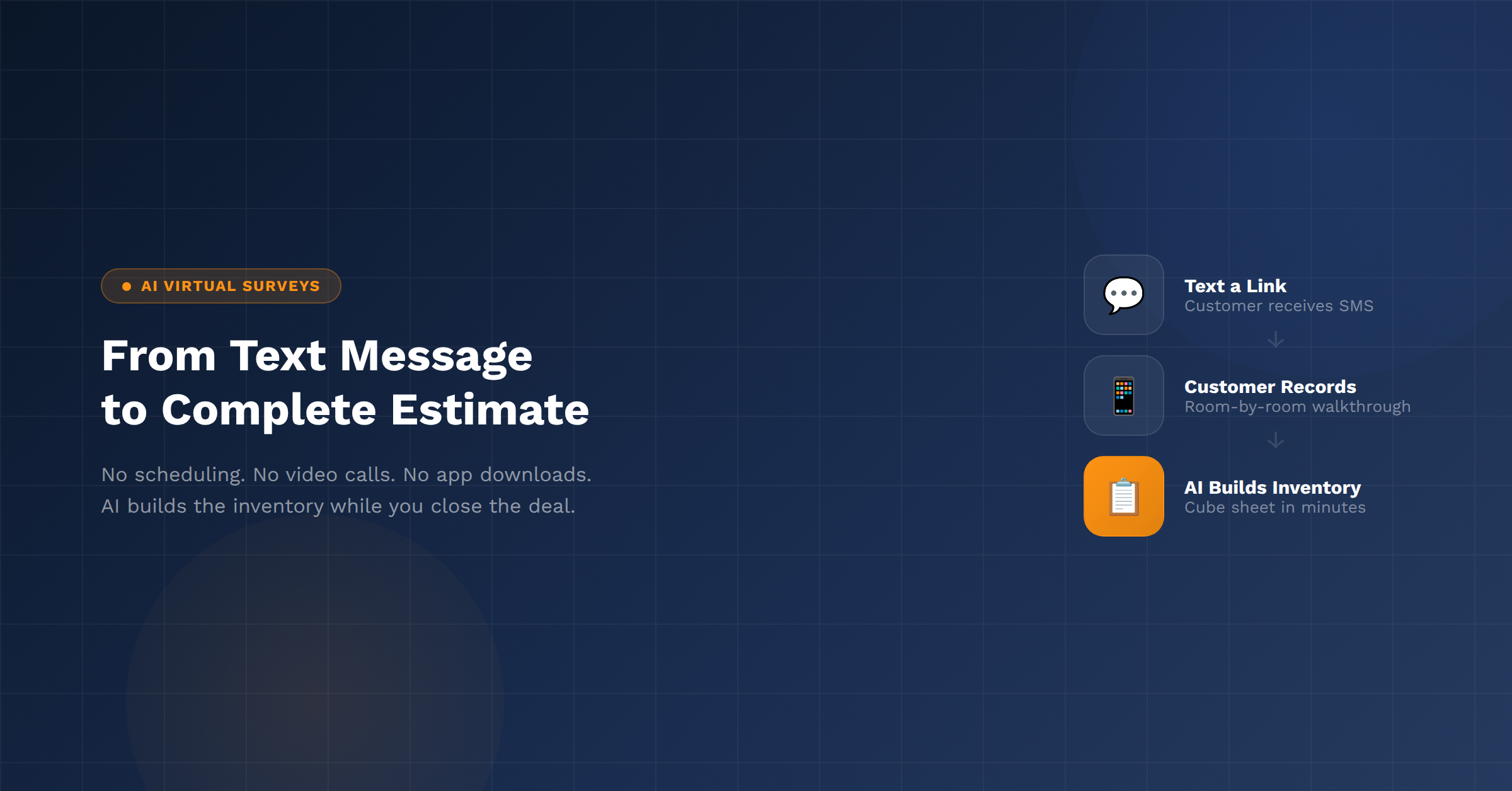
An AI-powered virtual in-home moving estimate works differently. There's no live call. Instead, the process is asynchronous:
The customer doesn't need to coordinate schedules. Your rep doesn't need to be on a call. And the AI catches items that human estimators routinely miss — the boxes stacked behind the door, the storage closet that "isn't that full," the garage that somehow has a pool table in it.
Think of it this way: A video call is a meeting. An AI virtual survey is a form the customer fills out with their camera — except the AI fills in all the answers.
Every moving company knows that speed-to-quote matters. What most underestimate is how much it matters.
When a homeowner requests quotes, they're usually contacting two to four companies within the same hour. The first company to deliver a detailed, professional estimate has a significant conversion advantage — not because the price is always lowest, but because the customer's anxiety decreases once they have a real number in hand. They stop shopping.
With a remote moving quote platform powered by AI, your sales team can send the survey link the moment a lead comes in. The customer records at their convenience — during lunch, after the kids are in bed, whenever works for them. By the time your competitor is still trying to schedule a video call for next week, you've already delivered the estimate.
That's not a marginal improvement. That's a structural change in how fast your sales pipeline moves.
The most common objection to any contactless moving survey tool is accuracy. Can AI really match what an experienced estimator sees in person?
The short answer: it often exceeds it. Human estimators round numbers, miss rooms, and rely on memory. AI processes every frame of video and identifies items forensically. Here's what the detection engine captures:
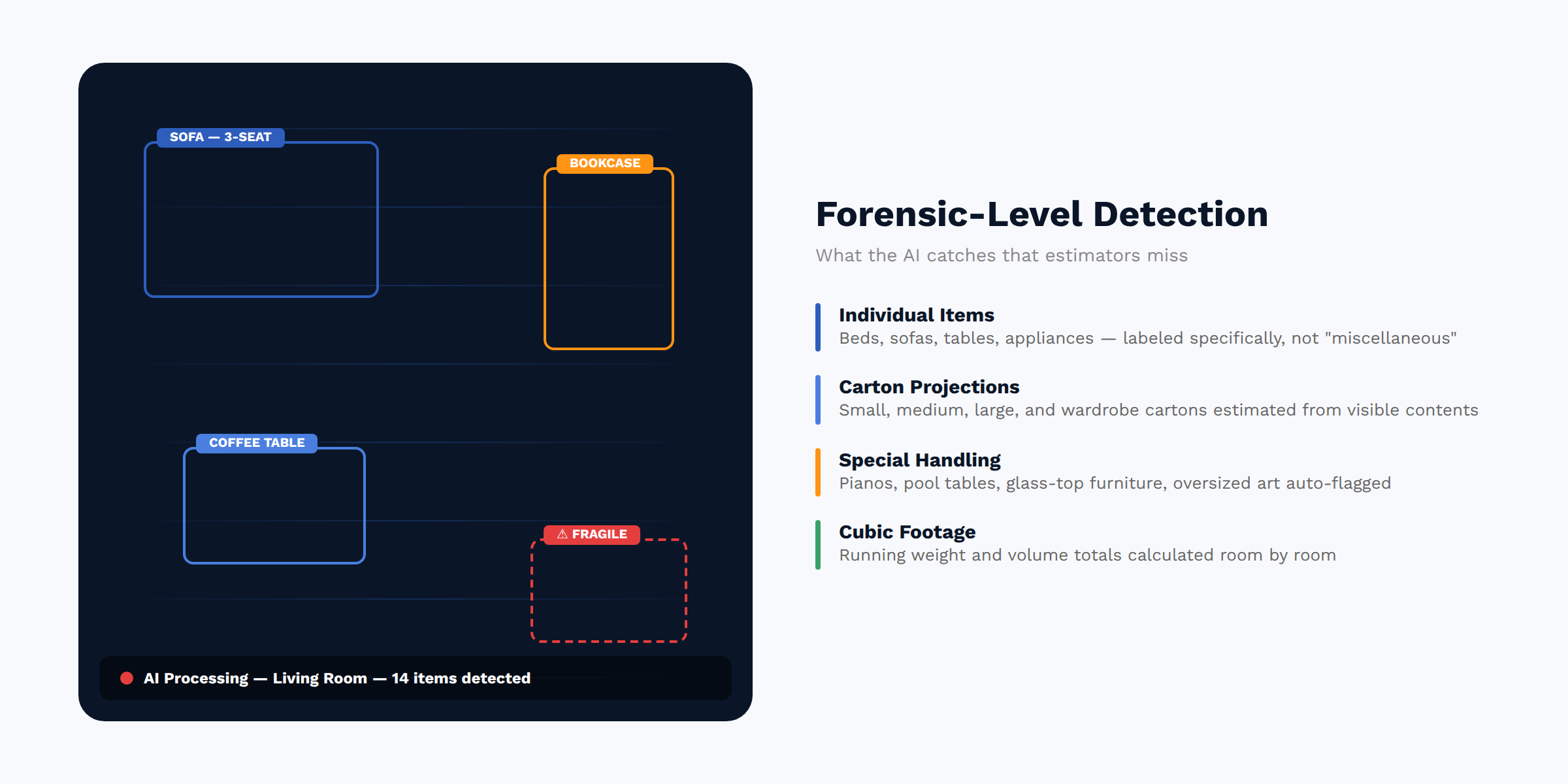
And because every detection is backed by the original video footage, you can rewind, verify, and manually adjust anything before finalizing the quote. It's not a black box — it's a highly efficient first pass that your team refines.
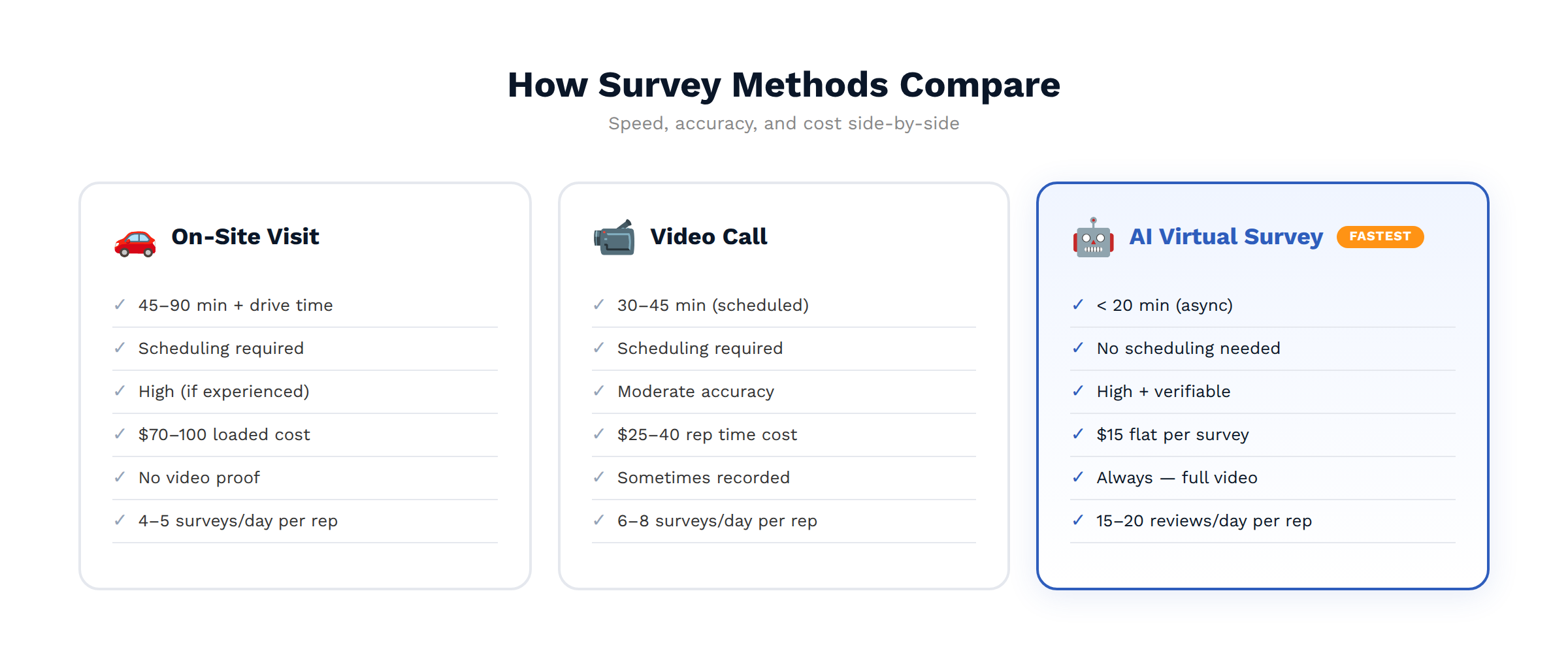
| Factor | On-Site Visit | Video Call | AI Virtual Survey |
|---|---|---|---|
| Time to complete | 45–90 min + drive time | 30–45 min (scheduled) | 10–20 min (async) |
| Customer scheduling | Required | Required | Not required |
| App download needed | No | Often yes | No — 100% browser |
| Rep time per survey | 60–120 min | 30–45 min | 5 min (review only) |
| Accuracy | High (if experienced) | Moderate | High + verifiable |
| Data format | Notes / cube sheet | Notes / cube sheet | Structured CRM data |
| Video proof for disputes | No | Sometimes | Always |
The biggest shift isn't any single row in that table. It's the combination: your sales team can handle significantly more leads per day because the AI moving estimate software eliminates the bottleneck of live survey time. A rep who previously did four to five video surveys a day can now manage fifteen to twenty AI survey reviews — because they're reviewing output, not conducting calls.
Here's a detail that seems small but has an outsized impact on completion rates: no app download.
Every moving company that has tried video-call-based surveys knows this pain. You send the customer a link. They need to download Zoom, or FaceTime isn't compatible, or their Android doesn't support the app. By the time they troubleshoot, they've lost interest — or patience.
A browser-based remote house survey for moving eliminates that friction entirely. The customer taps a link in their text messages. Their camera opens. They record. Done. It works on any smartphone — iPhone, Android, any age. If the phone can take a video, it can complete the survey.
This isn't a convenience feature. It's a conversion feature. The difference between "download our app" and "tap this link" is the difference between a 50% completion rate and a 90%+ completion rate.
A studio apartment is easy. What about the five-bedroom house with a full basement, three-car garage, and a storage unit across town?
That's actually where AI virtual surveys outperform the alternatives most dramatically. In a video call, complex homes mean longer calls, more estimator fatigue, and more missed items. On an on-site visit, the estimator is rushing because they have two more appointments that afternoon.
With a video walkthrough for moving quote powered by AI, the customer records at their own pace. They can do the main house today and the storage unit tomorrow. The AI processes each recording independently and consolidates the inventory. There's no time pressure, no appointment window, and no human fatigue factor degrading accuracy in the final rooms.
For multi-stop or long-distance moves, this is especially powerful. The customer at origin records their home. The receiving agent can survey the destination. Both inventories feed into the same estimate — without anyone boarding a plane.
The direct cost of an AI survey is a fraction of what you're spending on on-site visits or video calls. But the real economic case is in what you stop spending:
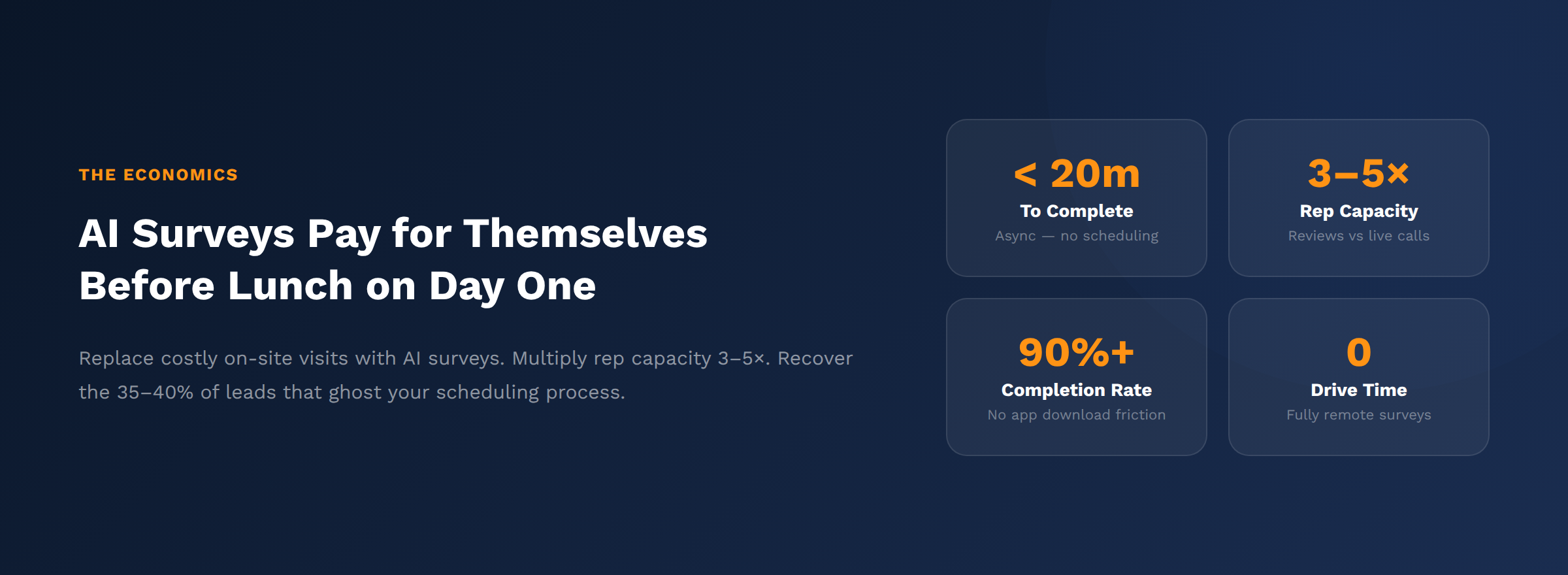
Moving companies running twenty to thirty surveys per week typically see the AI survey cost offset entirely by the reduction in drive time alone — before counting the revenue from faster booking rates.
An inventory sitting in a standalone tool is just data. An inventory that flows directly into your estimate workflow is a sales accelerator.
HomeSurvey.ai's Virtual AI Surveys push the completed inventory — room-by-room item list, cubic footage, weight estimate, carton projections, and special handling notes — directly into the CRM. From there, your team can generate the estimate with pre-populated data, attach the inventory PDF to the customer-facing quote, and hand off to operations with a complete scope — all without re-keying a single item.
For companies using other CRMs, the same AI engine is available through HelixIQ with webhook integrations for SmartMoving, HubSpot, Zoho, and other platforms via Zapier.
The fastest way to evaluate whether AI virtual surveys fit your sales process is to try one on your own home. Text yourself the link, walk your living room, and see what the AI produces. It takes less time than reading this article did.
Virtual AI Surveys are included in every HomeSurvey.ai plan. If you're already on HomeSurvey.ai, you can start using them today. If you're not, they're also available standalone through HelixIQ — no long-term contract required.
Activate your free trial now to run a live survey and watch the AI build an inventory in real time.
Start Free Trial → No commitment. No credit card. Just the demo.