Every moving company has this conversation on move day. The crew shows up. The scope is bigger than the estimate. There's a sectional sofa that wasn't on the inventory. Half the garage is loose items that were described as "a few boxes." The attic — the one the customer said was empty — has a treadmill, holiday decorations, and thirty years of yearbooks.
Your crew now has a choice: absorb the extra work to keep the customer happy, or stop the job and argue about price. One costs you money. The other costs you time, a review, and probably a referral. Most crews — because they're good people trying to do a good job — just absorb it.
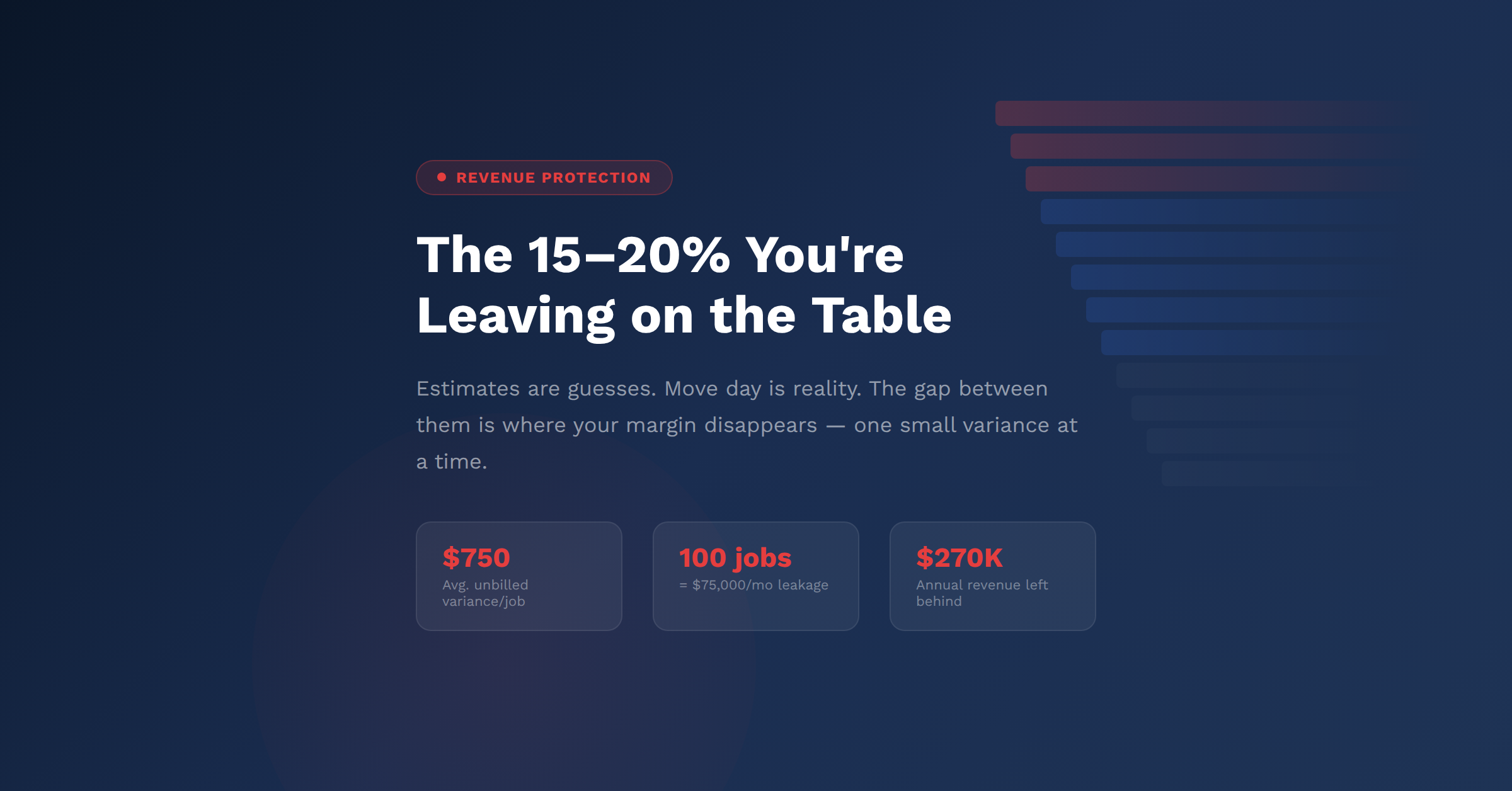
And that's where 15–20% of your revenue disappears.
Not in one catastrophic event. Not in a failed collection. It disappears in a hundred small variances across a hundred jobs — each one too small to fight over individually, but collectively large enough to crush your margins.
Revenue leakage in moving isn't a mystery. The cause is simple: estimates are guesses, and move day is reality. The gap between them is your margin erosion.
Here's where the variance typically comes from:
None of these are unusual. They happen on virtually every job to some degree. The question isn't whether variance exists — it's whether you have documentation to capture it.
The real cost: On a $5,000 local move with a 15% unbilled variance, you're leaving $750 on the table. Across 30 jobs a month, that's $22,500/month — or $270,000 a year — in revenue your crews earned but your company never collected.
Most moving companies have a change order process in theory. In practice, it almost never works well. Here's why:
The crew can't quantify the variance. They know the job is bigger than quoted, but they can't articulate by how much. "There's more stuff" isn't a change order — it's an argument. Without specific data, the crew either guesses at an adjustment or lets it go.
The customer disputes the change. Even when the crew attempts a change order, the customer pushes back. "This was all here when your estimator came." "That was included in the quote." "No one told me that would cost extra." Without photographic proof of what was quoted versus what showed up, the conversation devolves into "he said, she said."
The process is too slow. Filling out paperwork while the clock is running and the truck is half-loaded feels like the wrong priority. Crews are incentivized to keep moving, not to stop and document. So the variance goes unrecorded and the revenue goes uncollected.
The result: most change orders only capture the most egregious scope changes — the full piano that wasn't on the list, the second storage unit that appeared — and miss the dozens of smaller variances that add up to far more.
The Move-Day Audit is a second AI scan — performed on move day — that compares the original estimated inventory against what's actually on the truck. It uses the same AI moving estimate software that powers Virtual AI Surveys, applied to a different moment in the job lifecycle.
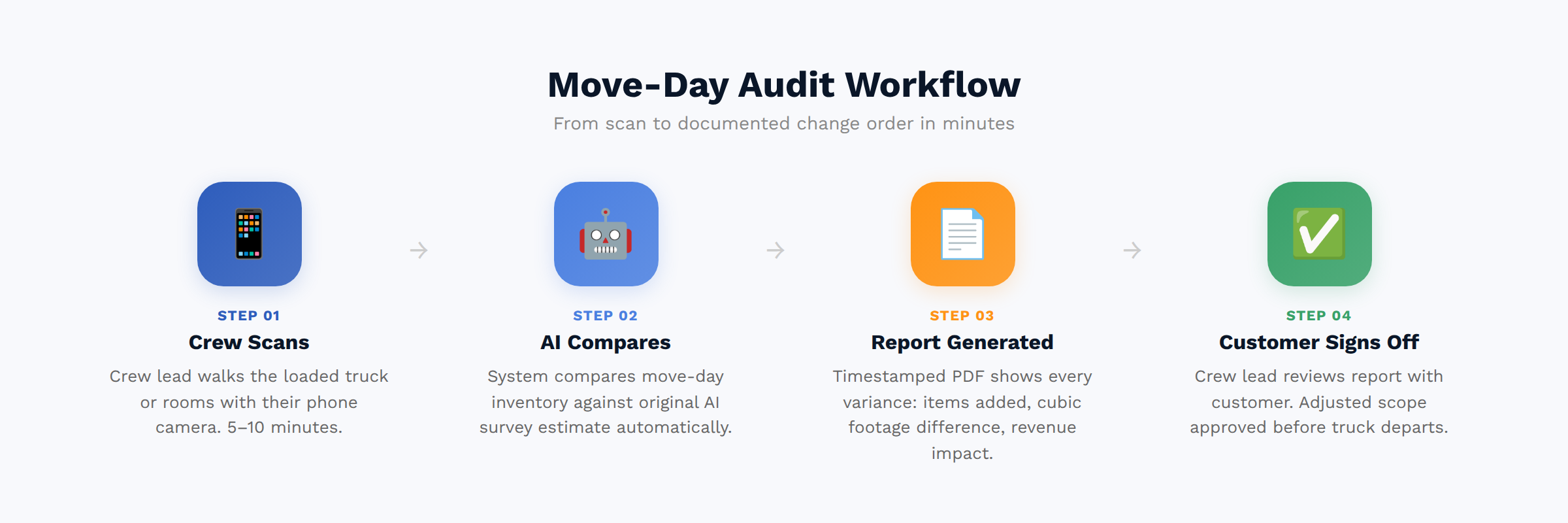
Here's how it works:
The key insight: The Move-Day Audit doesn't create conflict. It resolves it. When the customer sees a side-by-side comparison with their own home's video footage as proof, the conversation shifts from "you're overcharging me" to "I see — I didn't realize how much was added."
Original AI Survey Estimate: 10,200 lbs | 1,285 cu ft | $4,800 quoted
On move day, the crew arrives and notices the garage is significantly fuller than the estimate captured. The customer's adult daughter has also moved back home since the survey — her bedroom furniture and boxes are now part of the scope. The crew lead scans the home with his phone in 8 minutes.
| Category | Original Estimate | Move-Day Audit | Variance |
|---|---|---|---|
| Total Weight | 10,200 lbs | 12,650 lbs | +2,450 lbs |
| Cubic Footage | 1,285 cu ft | 1,590 cu ft | +305 cu ft |
| Cartons | 42 | 58 | +16 cartons |
| Large Items Added | — | Queen bed, dresser, desk | +3 items |
| Revenue Impact | $4,800 | $5,950 | +$1,150 recovered |
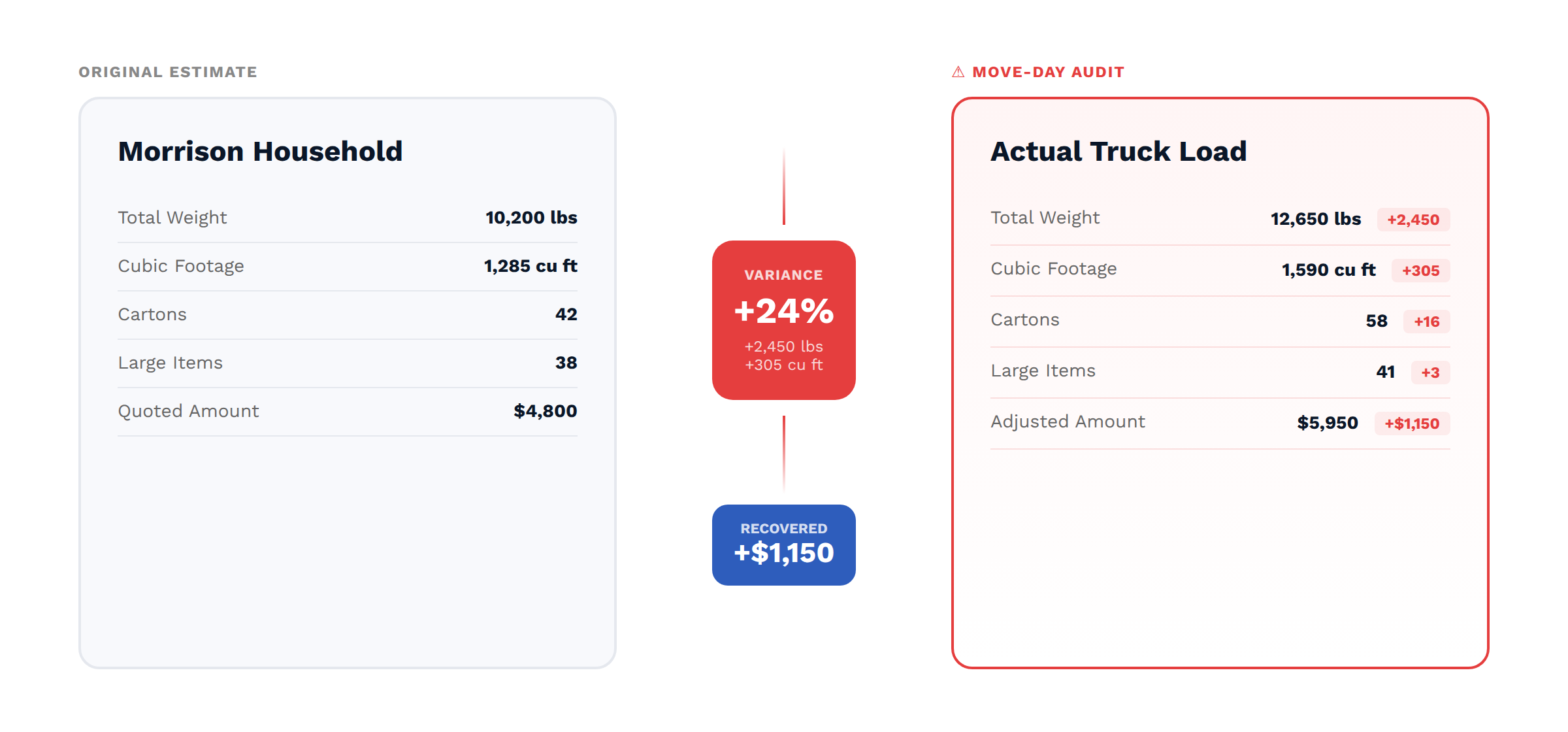
Without the audit, that $1,150 gets absorbed. The crew does the work, the customer pays the original quote, and the company eats the difference. With the audit, the crew lead shows the customer the PDF comparison on his phone, walks through the specific additions, and the customer signs off on the adjusted scope before the truck leaves.
No argument. No "he said, she said." Just data.
Let's make the math concrete for a company doing 100 jobs per month:
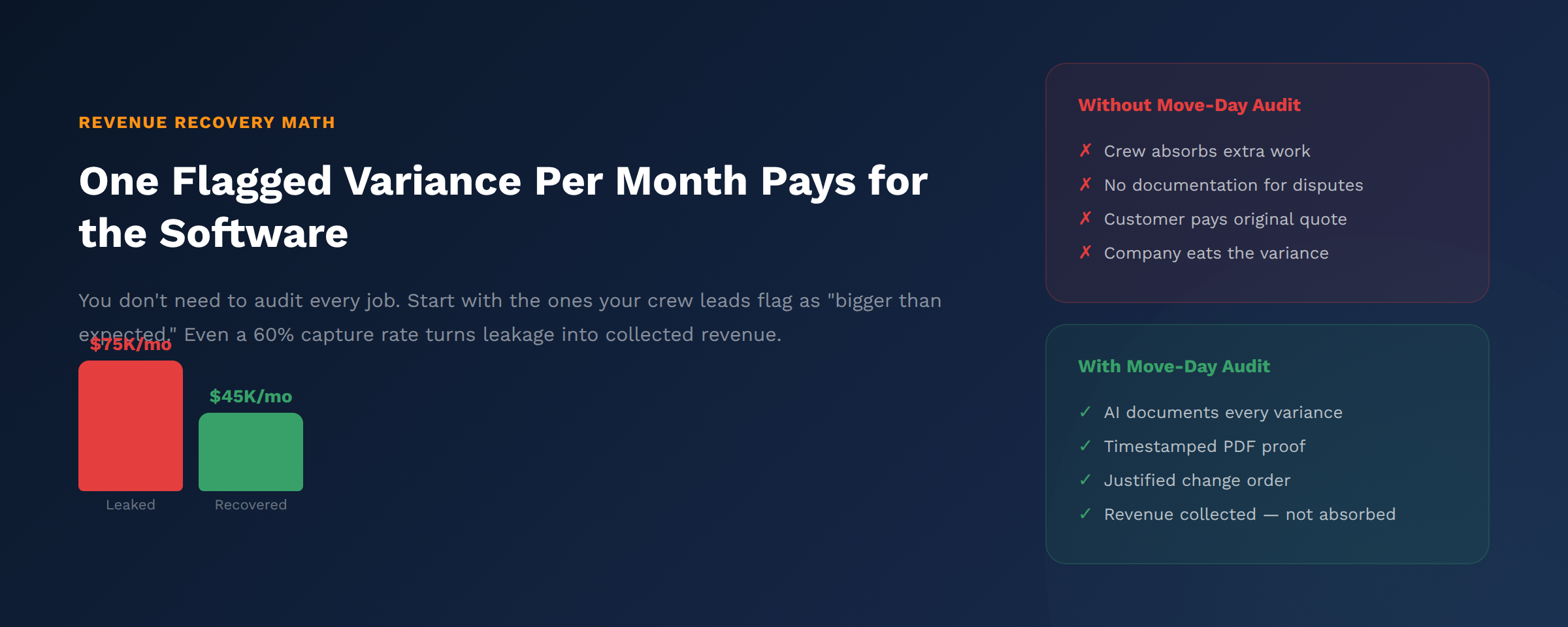
You don't need to audit every job. Start with the jobs your crew leads flag as "bigger than expected." If you're running Move-Day Audits on even 30–40% of your jobs and recovering a portion of the variance on each, the ROI is staggering. A single recovered variance per month — one — covers the cost of the software for the entire year.
This isn't theoretical margin. It's revenue your crews are already earning. The Move-Day Audit simply makes sure you collect it.
The Move-Day Audit isn't a separate system your operations team needs to learn. It uses the same virtual moving survey software and the same AI detection engine as the pre-move Virtual AI Survey. The workflow slots into the existing job lifecycle:
For crew leads, the additional time is five to ten minutes — a scan and a brief walkthrough of the report with the customer. For the company, the payoff is documented revenue recovery on every job where the scope changed.
Revenue recovery is the primary use case, but the Move-Day Audit has a secondary benefit that operations managers appreciate just as much: claims defense.
When a customer files a damage claim after the move, the typical dispute comes down to pre-existing condition. Was the scratch on the dresser there before? Was the TV already cracked? The customer says no. The crew says yes. Nobody has proof.
The Move-Day Audit's video footage — captured before items go on the truck — creates a timestamped visual record of item condition at origin. It doesn't eliminate claims entirely, but it gives your claims team something they almost never have: evidence.
Combined with the QR-code digital inventories that document condition at delivery, you now have a visual chain of custody for high-value items — from origin to destination, with AI-generated documentation at both ends.
The most common concern operations teams raise about move-day auditing is the customer's reaction. Won't it feel confrontational? Won't it slow down the job? Won't the customer think we're trying to gouge them?
In practice, the opposite happens. Here's why:
Transparency builds trust. When a crew lead says "Let me scan what we're loading so we're both on the same page," the customer sees professionalism, not aggression. You're showing them exactly what they're paying for — item by item, with data. That's the kind of experience that generates five-star reviews, not complaints.
The data does the talking. Crew leads don't have to argue about scope. The PDF comparison shows the variance visually. Customers can see the specific items that were added. It's not a negotiation — it's a fact sheet.
It's fast. Five to ten minutes at the beginning of the job saves thirty minutes of confusion, phone calls to the office, and customer disputes at the end. Front-loading the documentation makes the entire move day run smoother.
The Move-Day Audit is available as part of HomeSurvey.ai. If your company is already running AI Virtual Surveys for pre-move estimates, enabling move-day audits is as simple as sending a second survey link on the day of the job.
For companies new to AI-powered surveys, the fastest way to evaluate the system is to run a single end-to-end test: do an AI Virtual Survey on a job this week, then run the Move-Day Audit on the same job. Compare the variance report against what your crew would have caught manually. The delta between the two is your revenue recovery opportunity.
Three practical tips for rollout:
Activate your free trial now to see the Move-Day Audit in action.
Start Free Trial → Included with HomeSurvey.ai. Also available standalone through HelixIQ.