Walk into most moving company warehouses and you'll find the same system keeping everything running: a whiteboard on the wall, a spreadsheet on someone's desktop, and a warehouse manager who holds the real inventory in his head. Ask him where vault 237 is, and he'll tell you. Ask anyone else — while he's on vacation, out sick, or working in a different section of the building — and the answer is a blank stare.
This is how storage revenue leaks. Not through a single catastrophic failure, but through a steady drip of small inefficiencies that compound into serious money: an empty vault that never gets rented because nobody realized it was available, a billing cycle that slips by two weeks because the invoice was manual, a damage claim that gets paid because there's no documentation of what went in and out of storage.
Storage is supposed to be the high-margin annuity that stabilizes a moving company's cash flow between seasons. In practice, most warehouses operate well below their revenue potential — not because demand isn't there, but because the systems managing the space can't keep up.
Warehouse management software for movers exists to replace the whiteboard-and-memory system with something that scales. The question isn't whether you need it. It's how much you're leaving on the table without it.
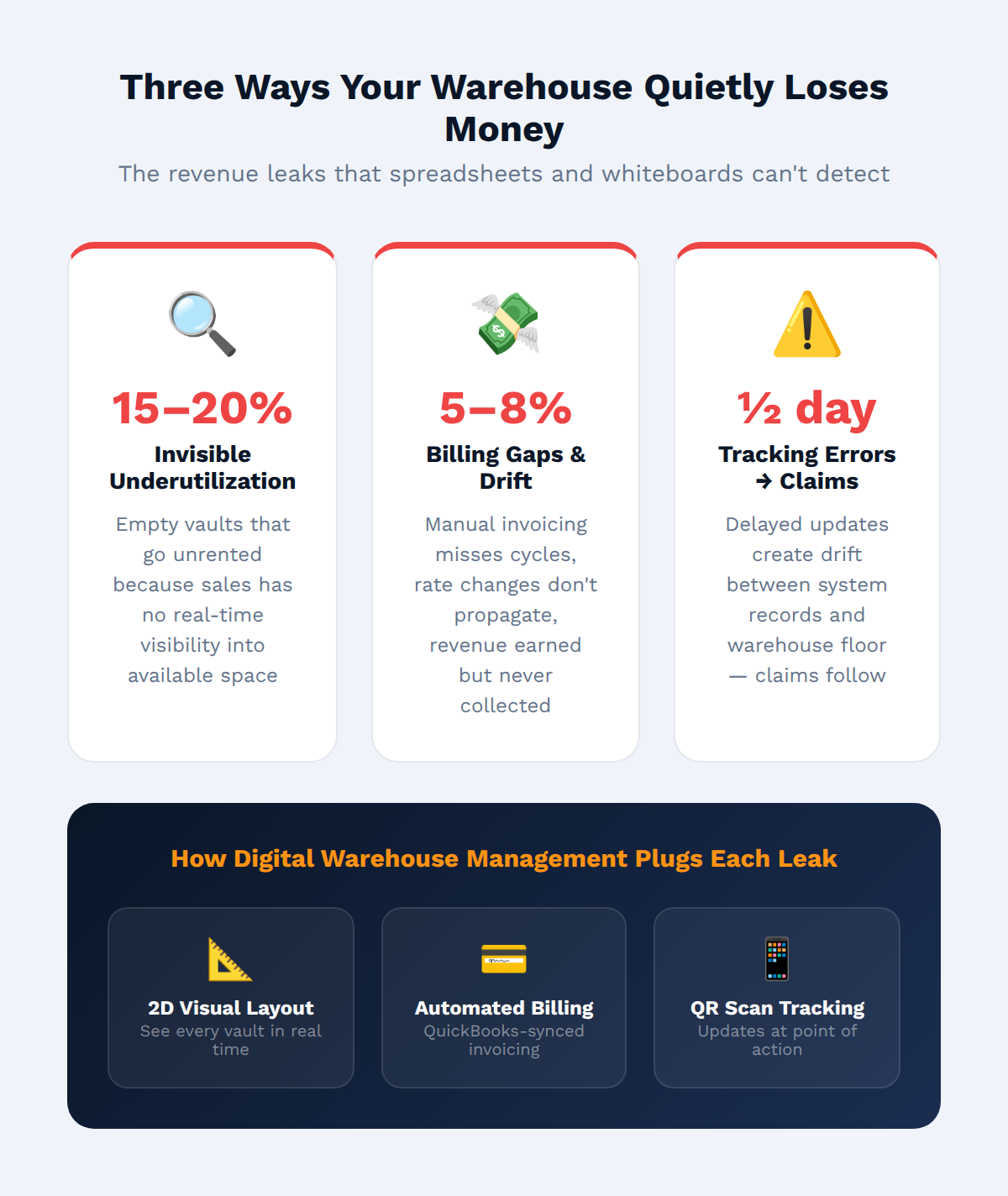
The most common form of warehouse revenue leakage is the kind nobody sees: empty vaults and racks that could be earning monthly storage fees but aren't — because the sales team doesn't have real-time visibility into what's available.
When your warehouse occupancy optimization depends on one person's mental map of the building, available space simply doesn't get rented. This compounds during peak season, when a sales rep might turn away a storage customer because they believe the warehouse is full — while 15 vaults sit empty on the far side of the facility. Without real-time visibility, "full" is just whatever the last person to walk the floor remembers.
For a warehouse running 300 vaults at an average monthly rate, even a 10% underutilization gap represents meaningful annual revenue that was available but never captured.
Manual storage billing is inherently slow and error-prone. Invoices go out late. Recurring charges get missed when an account changes hands or a rate adjustment doesn't propagate. For a warehouse with 200 active accounts, even a 5% billing error rate means 10 accounts being undercharged or unbilled every month. That compounds into thousands in revenue earned but never collected — a gap that's nearly invisible until someone runs an audit.
Every time a vault gets moved, an item gets added to storage, or a shipment goes out, somebody needs to update the record. With paper logs or spreadsheets, that update happens when the warehouse team has time — which means it doesn't always happen at all. The system says one thing, the warehouse floor says another, and reconciliation becomes a half-day project every month. Meanwhile, items get misplaced, vaults get assigned to the wrong customer, and claims follow.
Most warehouse management systems were designed for retail distribution — pallets, SKUs, and conveyor belts. Moving company warehouses don't work that way. They deal in vaults, racks, sofa racks, overflow bays, and shelving units. The relationships between customers, items, and physical locations are fluid, and they change constantly.
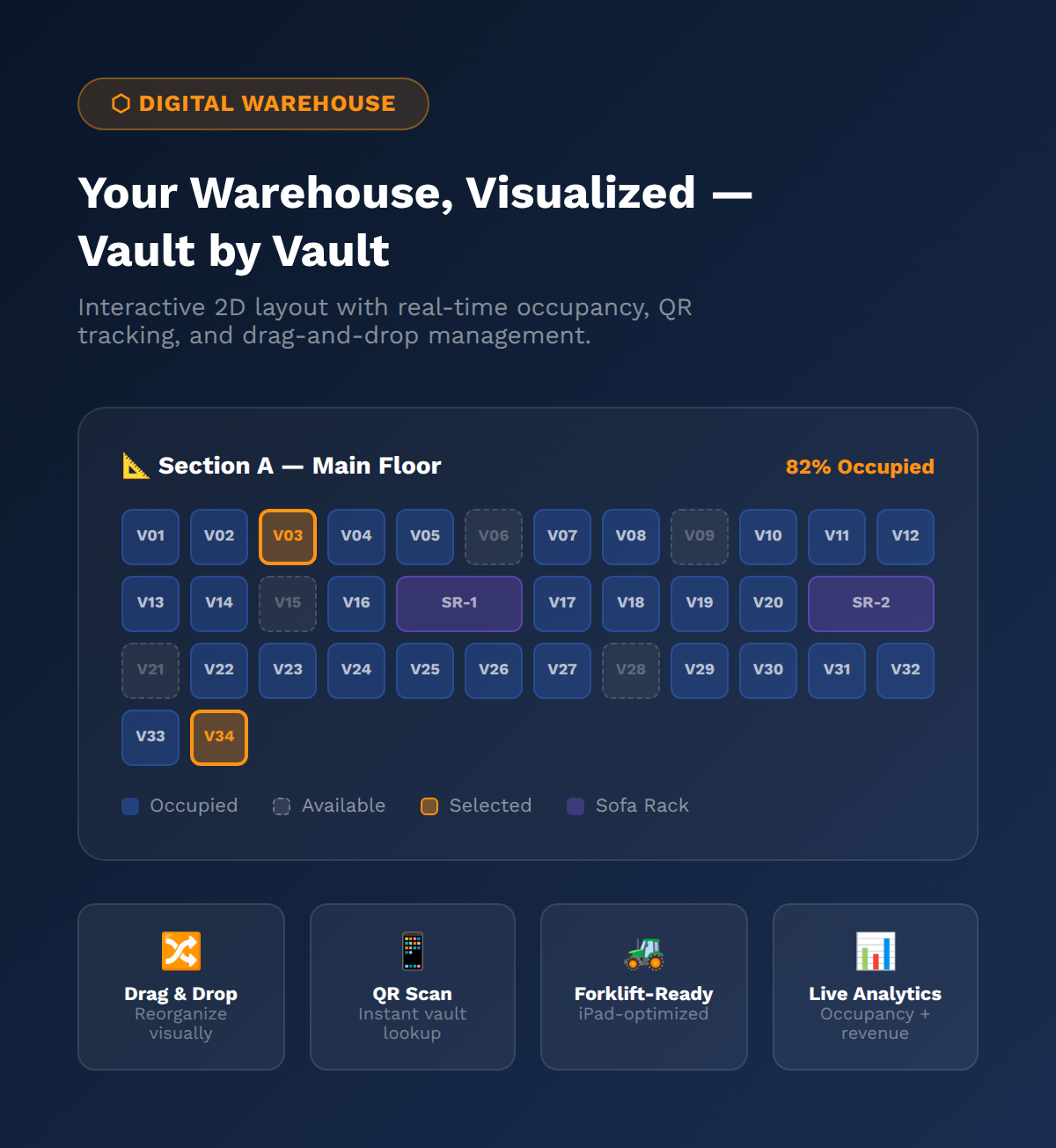
The HomeSurvey.ai Digital Warehouse is the first and only interactive 2D warehouse layout software built specifically for the moving industry. That specificity matters because it means the system models the way moving company warehouses actually operate — not the way a generic WMS thinks they should.
Here's what your operations team sees when they open it:
Built for the warehouse floor, not the back office. The 2D layout runs on iPads — including iPads mounted to forklifts — giving operators real-time access to vault locations, contents, and retrieval paths directly where the work happens. No walking back to a desktop. No radio calls to the office.
The 2D floor plan tells you where things are. QR-code scanning tells you what's inside and who it belongs to.
Every vault, rack, and storage location gets a QR label. Scanning that label with any phone or tablet instantly displays the contents, customer assignment, check-in date, and condition documentation. Checking items in or out is a scan-and-confirm operation — no manual log entries, no data entry at the end of the shift, no drift between the system and the floor.
For warehouse inventory tracking, this eliminates the entire category of errors caused by delayed or forgotten manual updates:
This is where digital warehouse and digital inventory systems converge. The warehouse knows where things are. The inventory system knows what condition they're in. Together, they create a complete chain of custody from origin to storage to final delivery — the kind of documentation that turns a "your word against theirs" claim dispute into a three-click resolution.
| Capability | Spreadsheet / Whiteboard | Digital Warehouse |
|---|---|---|
| Vault visibility | One person's memory + spreadsheet | Interactive 2D floor plan |
| Available space | "Let me check and call you back" | Real-time occupancy dashboard |
| Item lookup | 15–30 min in binders | QR scan — instant |
| Storage billing | Manual invoicing, periodic | Automated — QuickBooks synced |
| Vault reorganization | Physical move + manual record update | Drag-and-drop + auto-update |
| Damage claims | Paper vault logs — ambiguous | Photo + timestamp at every scan |
| Reporting | Manual spreadsheet aggregation | Live dashboards + historical queries |
| Multi-device access | Desktop only (or printouts) | iPad, tablet, desktop — forklift-ready |
A visual floor plan and QR scanning solve the operational problems — knowing what's where and tracking what moves. But the revenue impact comes from the analytics and automation layer that sits on top.
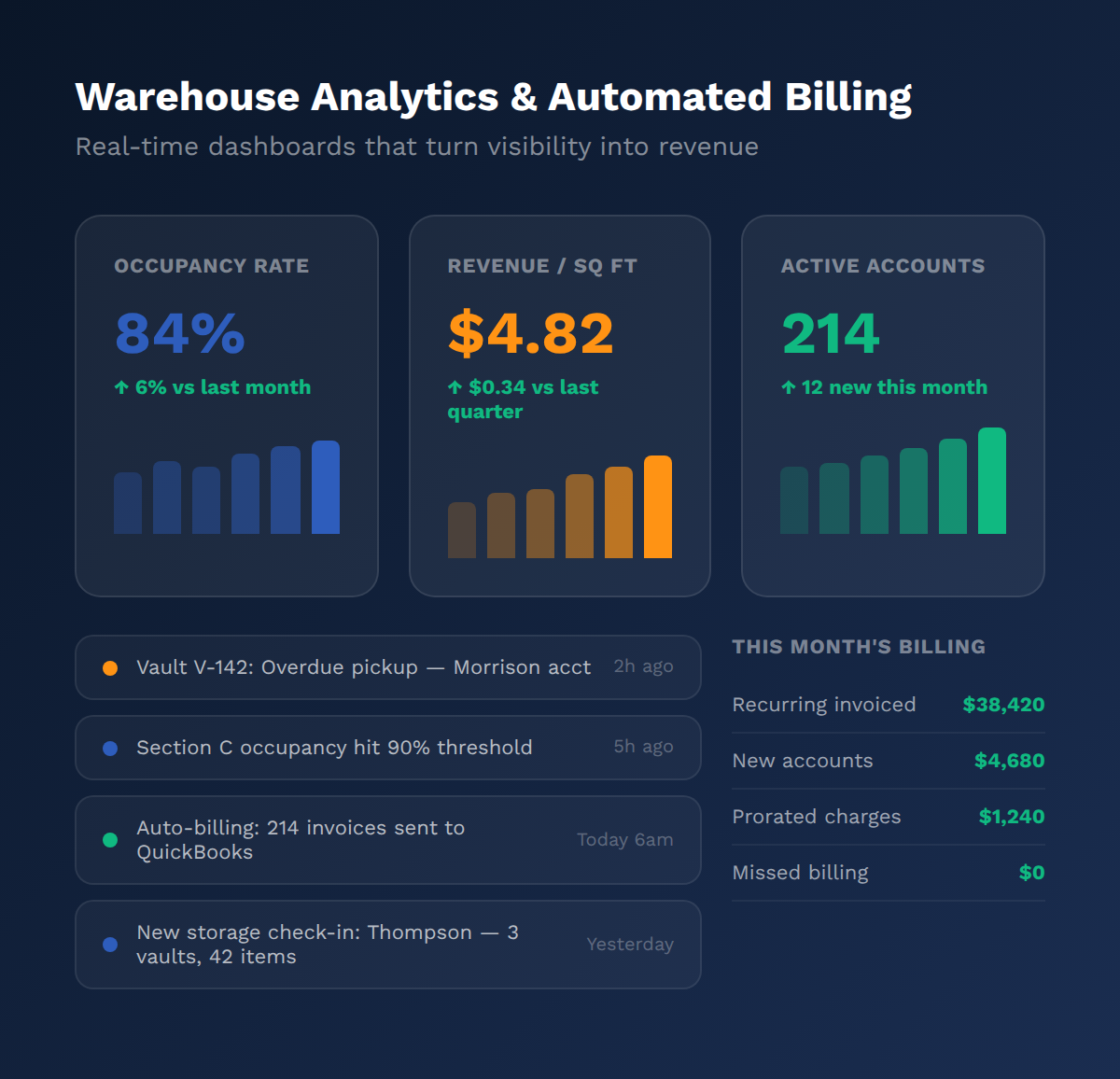
Real-time dashboards show occupancy vault by vault, section by section. Your sales team can see available space instantly when a storage inquiry comes in. Your operations manager can identify underutilized sections and rebalance layout to open up rentable capacity. This isn't monthly reporting — it's a live view that changes as items move in and out.
The system generates alerts when occupancy thresholds are reached, when billing is overdue, and when shipments are past their expected pickup date. These aren't generic calendar reminders — they're tied to specific vaults and customer accounts, so the right person takes action at the right time. No overbooking. No missed billing cycles. No revenue left on the table.
Automated storage billing generates invoices on the schedule you define — monthly, quarterly, or custom per account. New customers, rate changes, and prorated charges calculate automatically. Integration with QuickBooks means invoices flow directly into your accounting system with no double entry. The billing gap problem that costs most warehouses thousands per year simply stops existing.
Every vault movement, billing event, and occupancy change is logged and queryable. Average occupancy rate over the last 12 months? Revenue per square foot by section? Seasonal demand patterns by customer type? The data is there, ready to inform decisions about pricing, layout changes, and capacity planning.
Revenue per square foot is the metric that matters. Most warehouse managers track occupancy percentage, but the real measure of storage profitability is revenue generated per square foot. A 90% occupied warehouse with billing gaps and underpriced legacy accounts can generate less revenue than an 80% occupied warehouse with tight billing and optimized pricing. Smart analytics give you both views — and the data to close the gap.
Not all storage is equal. Designer services — managing furniture, art, and high-value personal items for interior designers, estate managers, and corporate clients — demand item-level precision that spreadsheets can't provide.
A storage vault management software system with QR-code tracking gives designer operations the accountability they need: every piece individually documented with photos, stored in a tracked vault, and retrievable with a single scan. When a designer calls about a client's antique credenza, you answer in seconds — not after a warehouse walk and a binder search.
For companies building a designer services revenue stream, this capability is a sales tool as much as an operational one. Showing prospective clients an interactive warehouse layout with real-time item tracking signals a level of professionalism that wins the kind of high-margin accounts that move the needle on annual revenue.
The HomeSurvey.ai Digital Warehouse is built for flexibility, not lock-in. It works three ways:
Whether you're managing 50 vaults or 5,000, the visual layout, QR tracking, and analytics scale the same way. And because it runs on iPads, tablets, and desktops, your warehouse team uses it where they work — not where the IT department put a desktop.
The most effective warehouse technology rollouts happen in stages, not overnight cutovers. Here's a practical four-week approach that keeps your operation running while the system fills in:
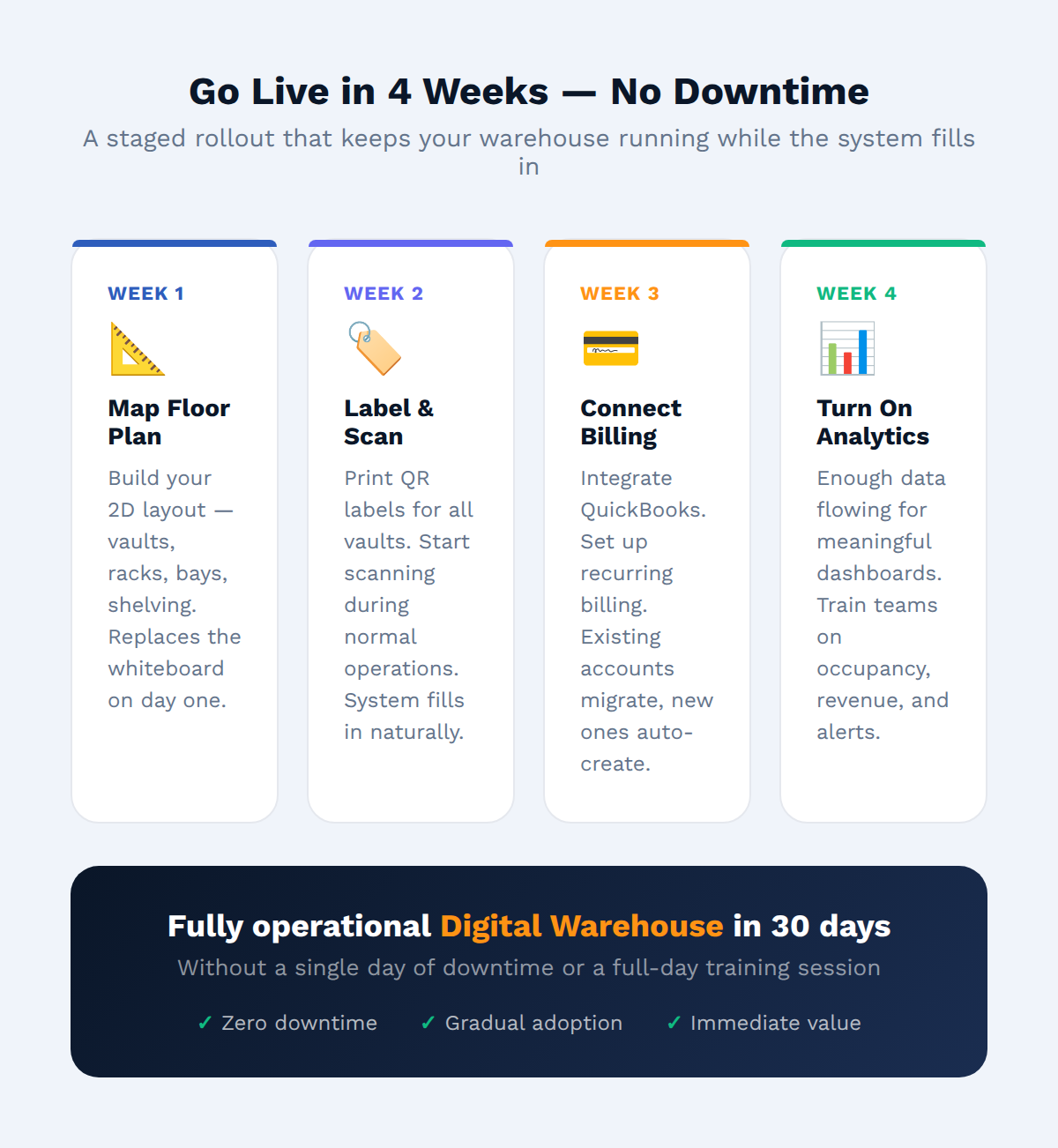
By the end of the first month, you have a fully operational digital warehouse for moving companies — without a single day of downtime and without asking your warehouse team to learn everything at once.
Book a demo and we'll walk your actual warehouse layout — vaults, racks, bays, and all — on the interactive 2D floor plan.
Book Your Demo → No commitment. No credit card. Just the demo.