There's a filing cabinet in nearly every moving company office that tells the same story: stacks of paper inventories covered in illegible handwriting, coffee stains, and abbreviations that made sense to the crew member who wrote them — six weeks ago. Now, with a damage claim on your desk and your only evidence being a crumpled sheet that reads "LG TBL — exc: scr," you're not defending anything. You're writing a check.
This isn't a crew problem. It's a documentation problem. And it's one of the most expensive line items that never shows up on an income statement.
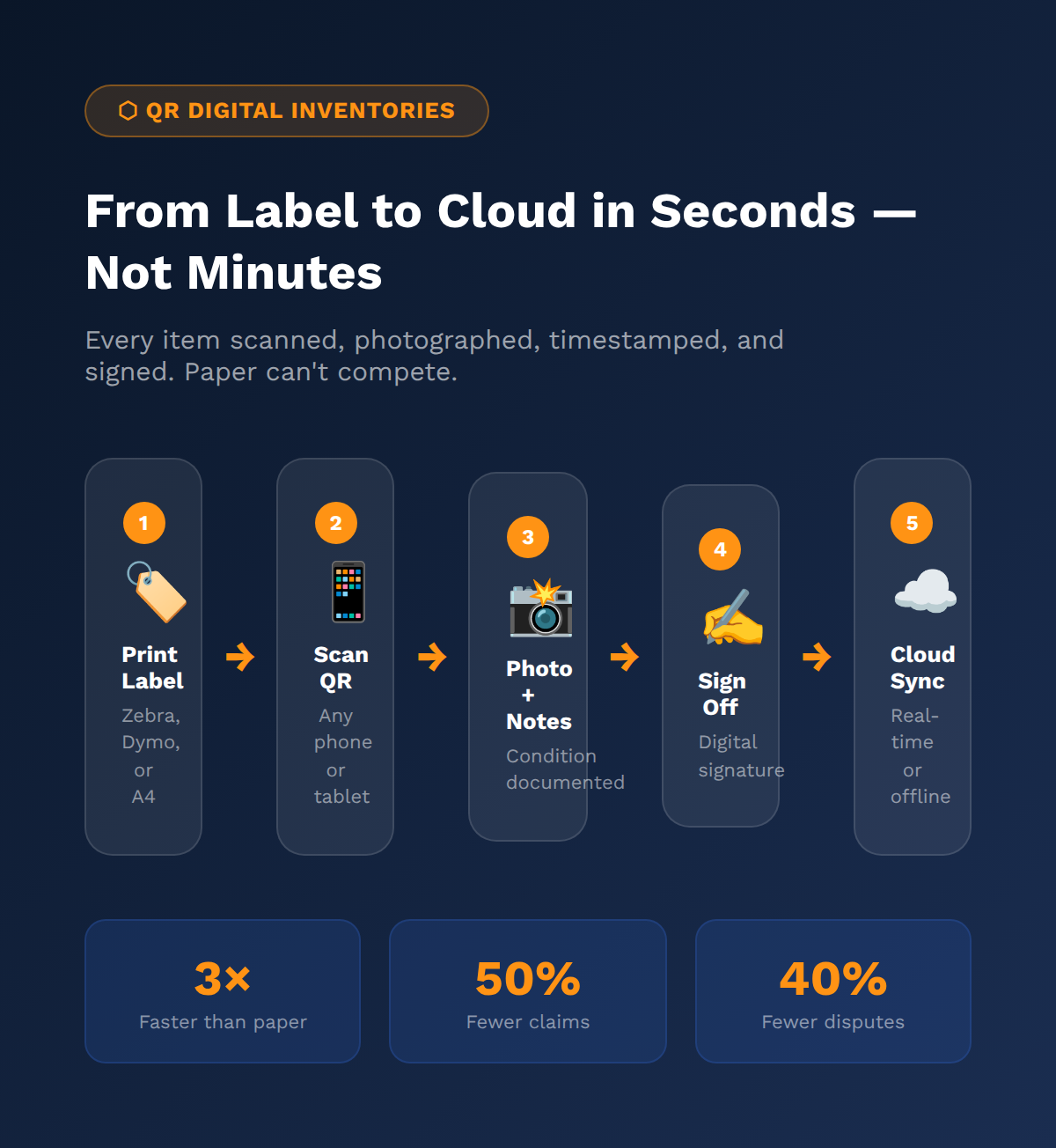
The moving companies that have figured this out aren't asking their crews to be better note-takers. They're replacing the notepad entirely with QR‑code digital inventories — mobile systems that scan, photograph, timestamp, and digitally sign every item in seconds. The result isn't just a faster inventory. It's a defensible chain of evidence that holds up when claims arise.
Yes, going paperless saves money on printing. The industry estimate is around $1,000 or more per crew per year on paper, ink, filing, and shredding costs alone. For a company running five crews, that's $5,000 annually that goes straight back into the operation.
But paper costs aren't why this matters. Claims costs are.
Consider how a typical claim unfolds under a paper-based system. A customer says a dining table was scratched during the move. Your crew lead says the scratch was there at origin. The inventory sheet — eventually located in a stack from three weeks ago — reads "din tbl — ok." No photo. No timestamp. No way to verify whether "ok" meant "no pre-existing damage" or "item present and accounted for."
The claim gets paid. Not because the crew was negligent, but because the documentation is ambiguous. And ambiguous documentation always favors the claimant.
Now multiply that across a year. Companies that switch to digital moving inventory apps with QR-code tracking report cutting damage claims by up to 50% and customer disputes by 40% — not because the moves get more careful, but because the gray area where claims live gets eliminated by photos, timestamps, and digital signatures.
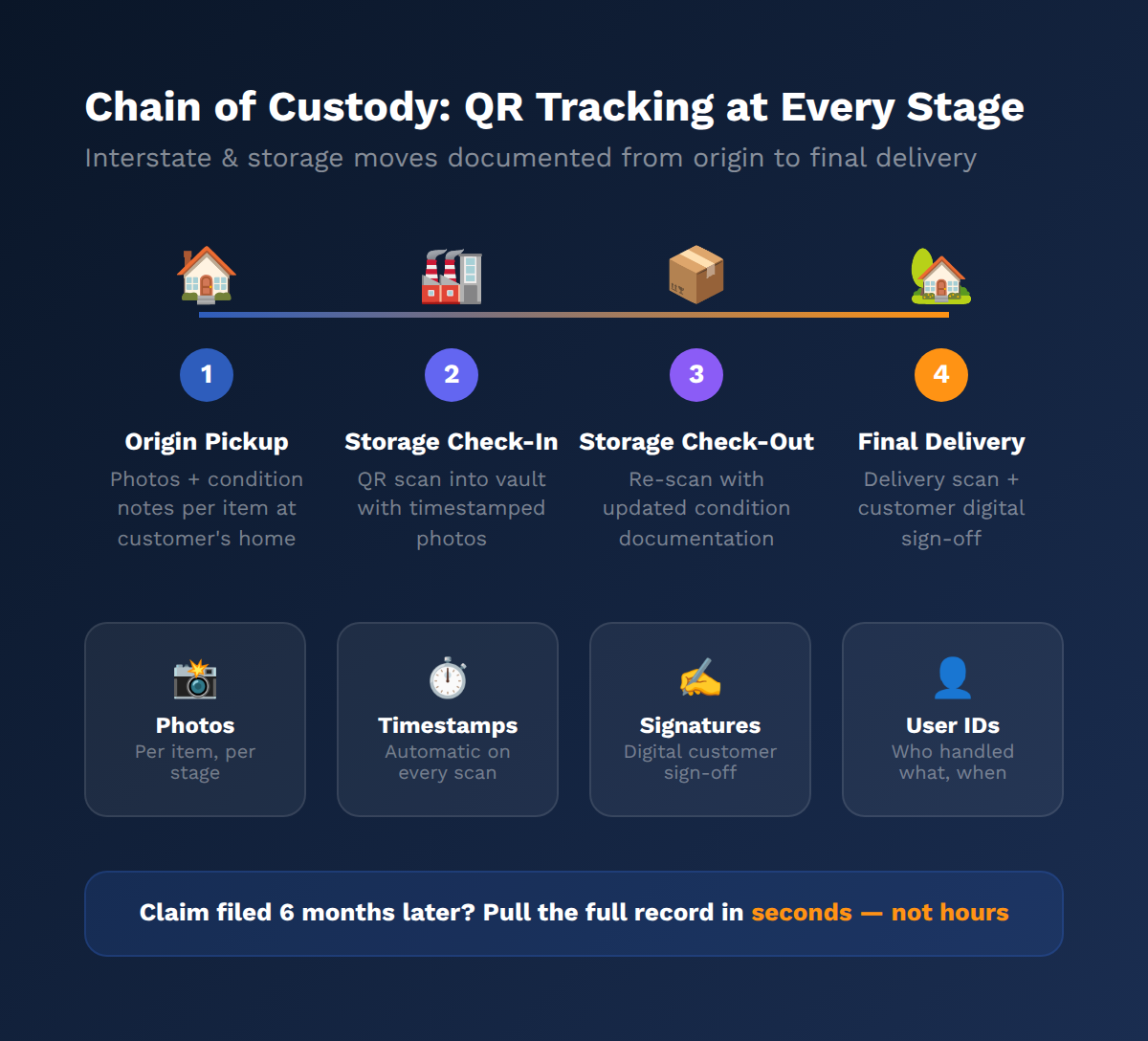
The concept is disarmingly simple: every item gets a QR-code label. Your crew scans it with their phone. The system captures the item record — condition photos, exception notes, timestamps, and customer signature — all in one place. Here's how it plays out on a typical long-distance or storage shipment:
Think of it this way: A paper inventory is your crew's memory of what happened. A QR-code digital inventory is proof of what happened — time-stamped, photographed, and signed.
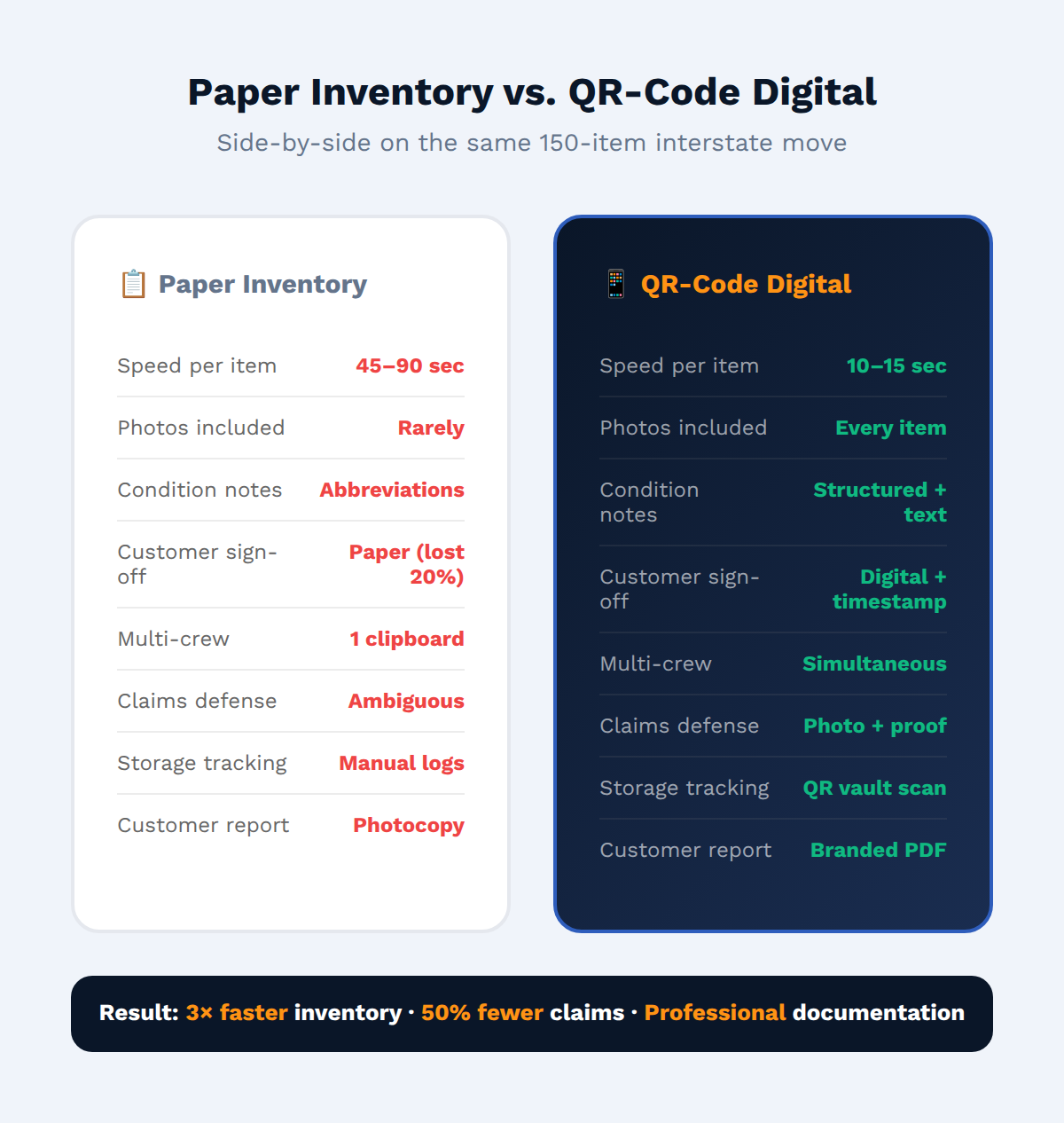
| Capability | Paper Inventory | QR‑Code Digital |
|---|---|---|
| Speed per item | 45–90 seconds | 10–15 seconds |
| Photo documentation | Separate camera (rarely done) | Inline — per item, per scan |
| Condition notes | Handwritten abbreviations | Structured + free-text |
| Customer sign-off | Paper (often misplaced) | Digital — timestamped |
| Multi-crew support | One clipboard at a time | Simultaneous on any device |
| Offline capability | Always offline (it's paper) | Full offline — auto-sync |
| Claims defense | Ambiguous — "he-said, she-said" | Photo + timestamp + signature |
| Storage chain of custody | Manual vault logs | QR-scanned vault tracking |
| Customer report | Photocopy of handwritten sheet | Branded PDF — downloadable |
A local move loads at 9 AM and delivers by 4 PM. The window for documentation to get lost — or for things to go wrong between handoffs — is small. The stakes are manageable.
Interstate, storage, and designer moves are a fundamentally different game. Items change hands multiple times. They sit in vaults for weeks or months. They get transferred between facilities. Every handoff is a potential claim, and every claim requires documentation that traces the item's condition at every single stage.
This is where a QR-code shipment tracking system earns its keep. When an item is checked into storage, the QR scan records who received it, when, and in what condition — with photos. When that item is retrieved three months later, another scan creates a new timestamped record. If the customer claims damage at final delivery, you pull up the full chain of custody in seconds: condition at origin, condition at storage check-in, condition at storage check-out, condition at delivery. Four data points instead of a faded line on a crumpled form.
For designer and high-value shipments: Every antique, artwork, and custom furniture piece gets its own individually documented record with photos and condition notes — not a line on a crowded inventory sheet. This is the level of precision that corporate relocation clients and interior designers expect, and it becomes a differentiator in proposals.
If you manage long-term storage alongside your moving operation, you already know the pain of paper-based vault management. Which items are in vault 47? When did the Morrison shipment check in? Did the customer add three boxes last month, or was that a different account?
With paper, the answer to every one of those questions is the same: "Let me check and call you back." And "checking" means flipping through a binder, cross-referencing handwritten vault logs, and hoping somebody updated the spreadsheet.
With digital inventories synced to a warehouse management system, every vault and rack gets its own QR label. Scanning a vault instantly shows every item inside, when it was checked in, and its documented condition. Adding items to storage or pulling them for delivery is a scan-and-confirm operation. No paperwork, no manual logs, no risk of losing track of what's where.
HomeSurvey.ai QR Inventories integrate natively with the HomeSurvey.ai Digital Warehouse — so items are tracked from origin through storage and out to final delivery in a single system. But they also work standalone with an open API, meaning you can connect them to your existing in-house systems without changing your core workflow.
"My guys won't use it" is the most common objection to paperless moving inventory systems. It's also the one that disappears fastest after a trial run.
Your crews already carry smartphones. They already know how to scan QR codes and take photos. HomeSurvey.ai QR Inventories work on iPhones, Android phones, iPads, and tablets — no special hardware, no extra devices to charge and carry. The learning curve is measured in minutes, not days, because the interface was designed specifically for field conditions: big buttons, fast scans, minimal typing.
But the more revealing insight is what crews say after they've used it. Paper inventories are tedious. Writing the same abbreviations hundreds of times per shift — TBL, CHR, BX-MED, BX-LG — is monotonous and error-prone, especially late in a long day. Scanning a code and tapping a screen is faster and less mentally draining. Fewer mistakes happen not because the crew is more careful, but because the system removed the opportunity for error.
Adoption stalls when a new system demands that every existing process change on day one. The best moving company inventory management tools offer flexibility in how labels get created and applied:
The point is that the underlying digital record is the same regardless of which labeling method you choose. You get the photos, the timestamps, the condition notes, and the digital signature no matter how the label gets onto the item.
Paper inventories look like what they are: rushed field notes. They don't build customer confidence and they don't differentiate your company in a competitive bid.
Digital household inventory software produces branded, professional PDF reports that customers can download, email, or reference at any time. These include item-by-item documentation with inline photos, structured condition notes, exception flags, and digital signatures. For a homeowner who just entrusted their life's possessions to your crew, receiving a clean, structured report — instead of a photocopy of a handwritten sheet — signals that your company operates at a different level.
For sales teams bidding on corporate relocation contracts, designer services, or military moves, these reports become a tangible proof point in proposals. You're not just saying "we're careful with your stuff." You're showing the documentation system that proves it.
The paper savings ($1,000+ per crew per year) and the speed gains (3× faster than handwritten inventories) are real, but they're not the headline number. The headline number is in the claims you stop paying.
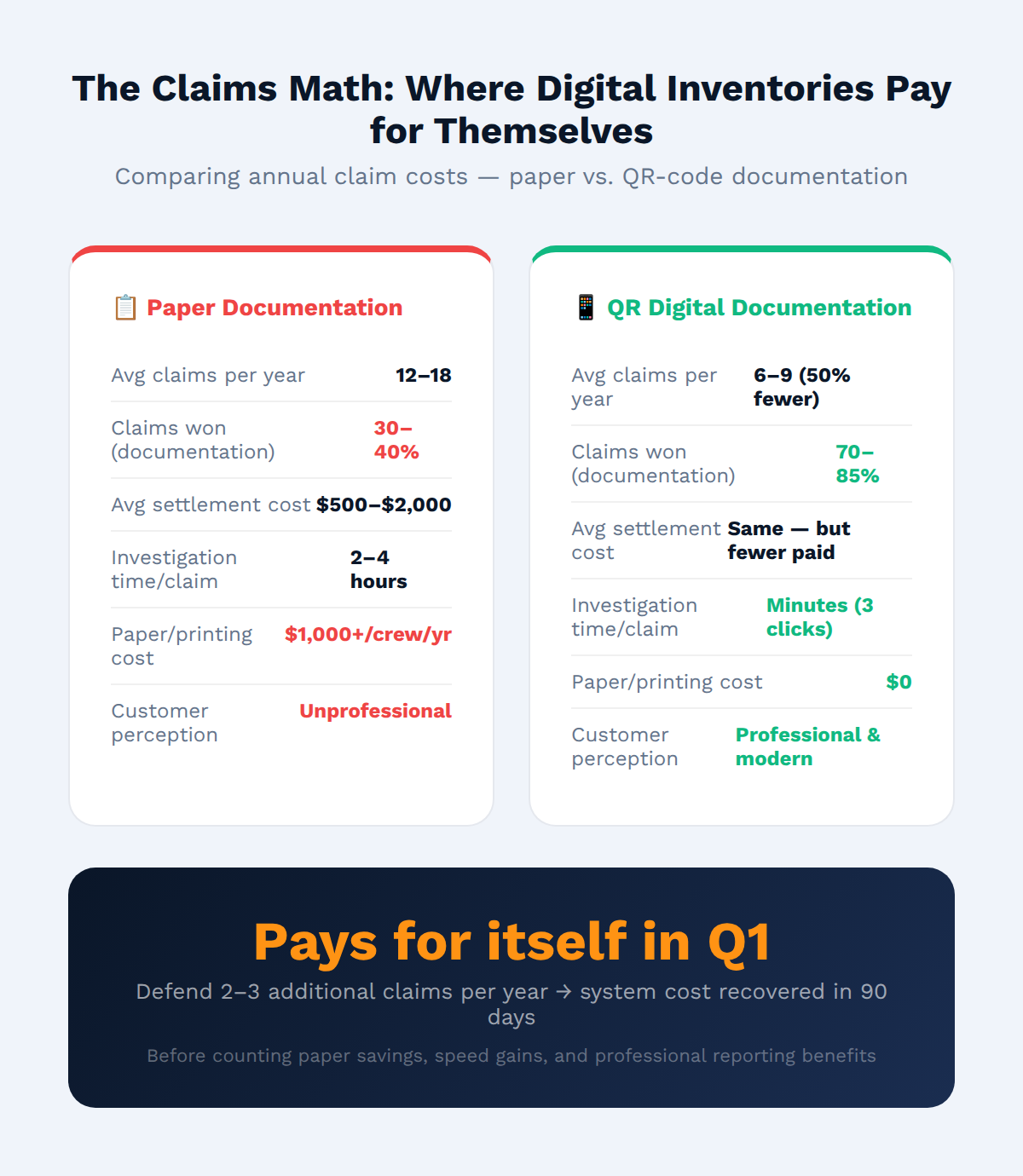
If a single disputed claim costs $500–$2,000 to resolve — between investigation time, settlement, and customer relationship damage — and QR-code digital inventories help you successfully defend even two or three additional claims per year, the system pays for itself in the first quarter. For companies handling interstate and storage moves, where claims volumes and average claim values are both higher, the payback period is even shorter.
The companies that have already made this switch — including national operations like All My Sons Moving & Storage, which uses digital inventories across all their locations — aren't going back to paper. The documentation is too defensible, the crews are too fast, and the customer experience is too visibly better.
Book a demo and we'll show you the full scan-to-sign workflow — including how it syncs with storage and warehouse management.
Start Free Trial → No commitment. No credit card. Just the demo.